 private
 The product
What exists today
Private Twin is an advanced prototype in validation. This page shows what it produces, what it looks like, and what is left to prove.
How it works
A reconstruction, not data entry
The agent observes the sources you authorise, attaches activity to the right projects, and rebuilds the current state of each. Nothing is asked of the user during the day: what is rebuilt is presented afterwards, for approval or correction.
The authorised traces of work, and only those: mail, calendar, files, project tool.
Link activity, meetings, communications and files to the right projects, people and clients.
Recompose the current state of the record: decisions, open actions, risks, evidence, effort.
Present the result as a proposal. Approving, correcting and refusing stay with the user.
Outputs
Three outputs, one engine
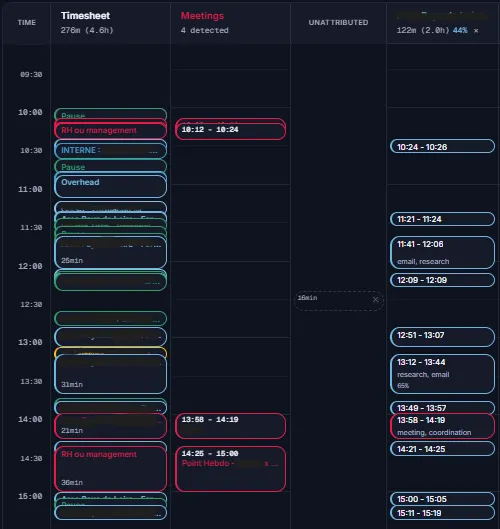
A defensible timesheet. Effort recovered, attributed to the right project, with the evidence that backs it.
Time is an output, not the promise. What is aimed at is a state of the project that is usable, sourced and justifiable.
A daily readout per project. What changed, what is moving, what is blocked, what is about to slip.
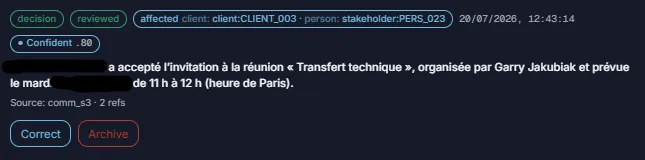
The actions to follow. Tasks and promises detected in real work, proposed for your approval and kept with their context.
All three come from the same execution record. You are not installing three products.
Screenshots
What it looks like
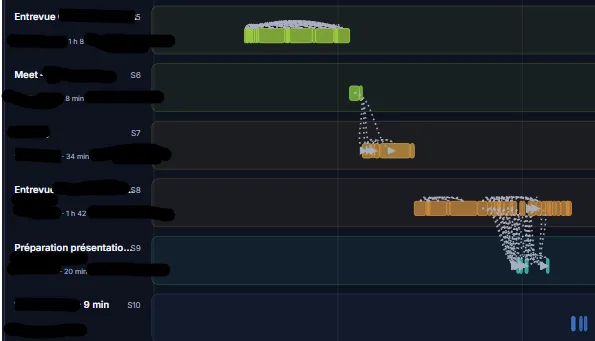
Three screenshots from the prototype running today. They do not show a finished product: they show that the reconstruction exists and produces readable output.
Difference
What these tools are not built to do
Each of these tools does one thing well. None of them is built to keep a project’s state current from the work actually done.
| Alternative | What it does well | Private Twin |
|---|---|---|
| Assistants and copilots | Dialogue, reasoning, generation, connectors. | Operational context already reconciled, attributed, sourced and durable. |
| Domain RAG | Document search, ontology, answers and deliverables. | Real execution beyond documents: timeline, interruptions, effort, open actions. |
| Time trackers | Automatic capture and attribution of time. | A record linking effort, decisions, actions, risks and evidence. |
| Tasks, PM, CRM | Explicit recording of tasks and statuses. | Detection of the gap between what is declared and what actually happened. |
| Process mining | Analysis of structured transactions. | Reconstruction of knowledge work from heterogeneous, uncertain traces. |
These players can technically converge. The difference is only defensible if Private Twin’s outputs are more reliable thanks to real activity and human validation.
Getting started
What it actually asks of you
- 01
Authorise the sources
You choose what the agent observes: mail, calendar, files, project tool. Nothing else. Each source is switched on and off separately.
- 02
Let it rebuild
The first days go into attaching activity to the right projects. What is rebuilt is proposed to you, never applied behind your back.
- 03
Correct it
Your corrections are the tuning. They then make up most of the data entry asked of you, and they shrink as the attribution gets it right.
How much that learning actually costs is part of what is being validated. It is one of the reasons I am looking for pilot teams rather than users.
Status
Built, and being validated
Built
- A complete prototype that collects, links and interprets different traces of work.
- An architecture designed to preserve context, sources and human approvals.
- A harness that limits dependence on language models and their providers.
- A working Sim Lab for monitoring, replay and version comparison.
Being validated
- Evaluating results across more days and more real situations.
- Improving features before switching them on for users.
- Identifying which customer profiles feel the problem most sharply.
- Validating usage, adoption and the value actually created.
Test the reconstruction on your own projects
I am looking for professional services teams of 5 to 50 people willing to run the reconstruction on their own projects, and tell me where it gets things wrong.