 private
 The living project record, kept current from the work itself
Open a project and find what changed, the decisions taken, the actions still open, the risks, the evidence and the effort spent, without rebuilding the story by hand across five tools.
Problem
Work moves forward. The record does not.
Work happens in email, meetings, files and tools. Nothing updates the state of a project on its own. As long as reporting rests on constant human discipline, it arrives late, stays vague, or omits a blocker, an owner, a next action or a deadline.
You reopen several tools and chase the team to reassemble a picture that is already partly out of date.
You decide on an incomplete picture: a lost action, a risk found too late, a deadline that slips.
When someone picks up a project, the deliverables are there, but not the trade-offs, the promises, the dependencies or the options that were ruled out.
The gap
Two stories of the same project
On one side what was planned: intentions, commitments, deadlines. On the other what actually happened: messages, meetings, files, tools. Private Twin brings the two together and makes the gap visible.
A gap is not a fault. It is often the most useful thing in the record: what was planned and never happened, what happened without ever being planned.
Outputs
Three outputs, one engine
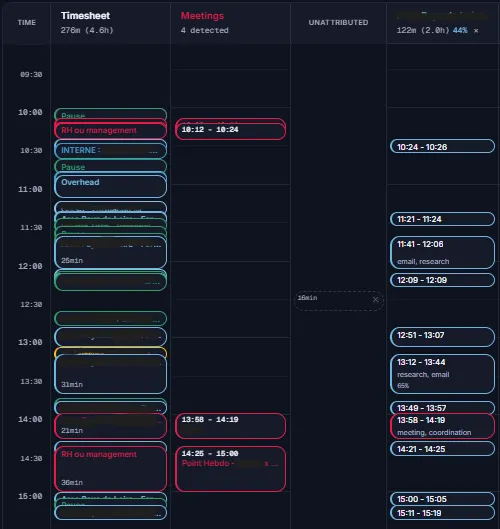
A defensible timesheet. Effort recovered, attributed to the right project, with the evidence that backs it.
A daily readout per project. What changed, what is moving, what is blocked, what is about to slip.
The actions to follow. Tasks and promises detected in real work, proposed for your approval and kept with their context.
Proof
It exists, and it produces readable output
Why now
The problem already costs. It is becoming structural.
Today, reassembling the state of a project costs time. Tomorrow, when execution and part of the coordination are spread across more actors — human and agent — the state of the work, the rights and the evidence become markedly harder to maintain. The arrival of agents sharpens the problem; on its own it does not justify a purchase.
Trust
Local first, and no score on anyone
Processing happens on your machine by default. No score, no screenshot, no productivity judgement. Every piece of state points back to what produced it, and what the system is unsure it understood is marked as such.
Talk
Test the reconstruction on your own projects
I am looking for professional services teams of 5 to 50 people willing to run the reconstruction on their own projects, and tell me where it gets things wrong.